TEAL MODIFICATIONS

Home | News | History | Production | Specs | Mods | Operation | Photos | Literature | Market | Contacts | Links

Teal owners and pilots agree that the few weak points of the original Teals are the lack of engine power and speed, high stalling speed and the 'conventional' (tail wheel) landing gear.

Considering the low number of Teals built (38), there are still a number of 'one of a kind' modifications and conversions that have been installed on Teals.  This section will try to describe all known Teal modifications and conversions.


Aeromarine Upgrades


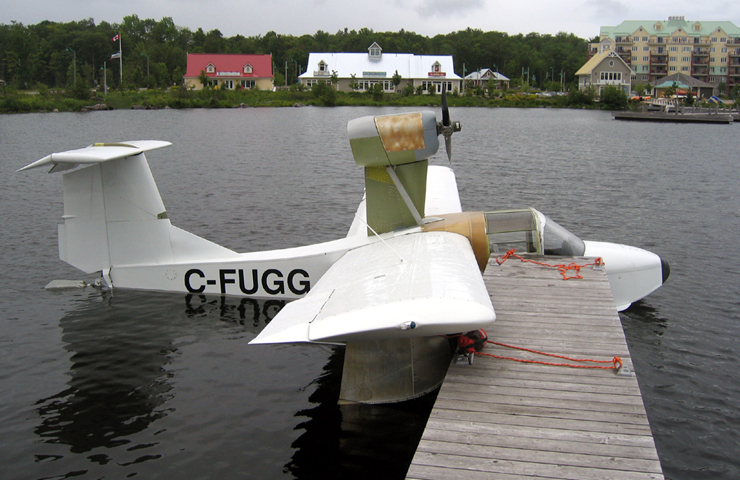
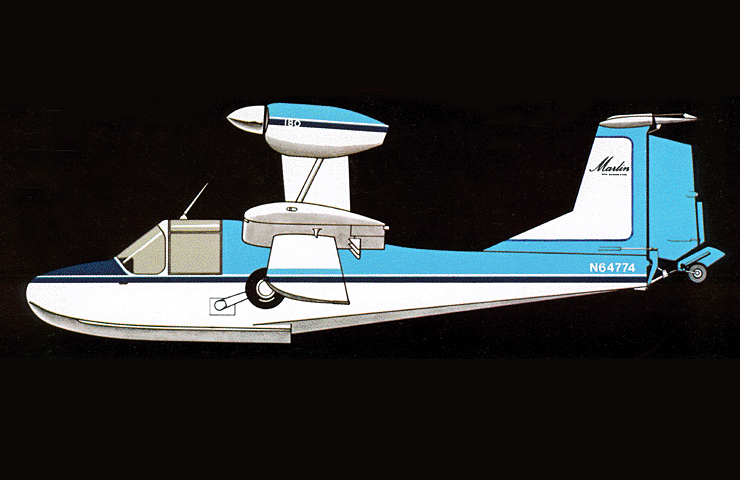
Model of Aeromarine Upgrades - Tricyle
Photo: © IAC

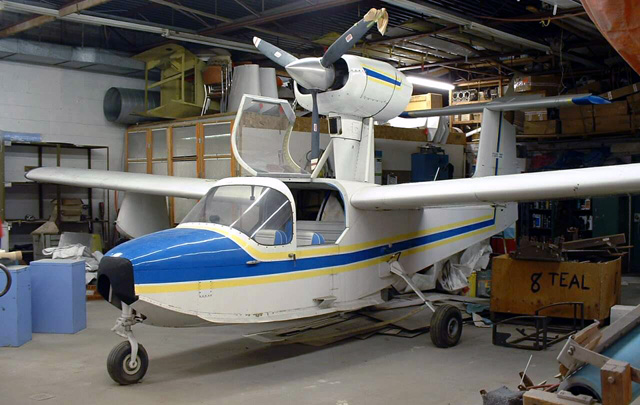
International Aeromarine Corporation of Fairhope, Alabama, have under research and development several sophisticated modifications and upgrades for the Teal amphibians.  Modifications under development include; tricycle landing gear, streamlined engine pylon, new wing tips, pods for aerodynamic streamlining of retracted main landing gear, strakes, etc. 

The two Aeromarine prototypes have been moved from Canada to Pennsylvania for final assembly, certification and flight testing, now (June 2008) estimated to start in about two months with the FAA being the wild card.

Two upgraded Teals, one featuring tricyle (Teal # 22) landing gear and one (Teal # 13) with conventional 'taildragger' landing gear are expected to fly during 2008.

The idea is to convey an aircraft that can cruise long range low and slow at 4 GPH or high and fast - 200 MPH @ FL200.  More information is expected soon.

For more information, please contact:

INTERNATIONAL AEROMARINE CORPORATION
Cpt Stephen Monteith Albers
54 N Church St #5
Fairhope, AL 36532-2425, USA
Fax: 251-928-5393
Phone: 251-928-1473
Email: info@internationalaeromarine.com

www.internationalaeromarine.com

Model of Aeromarine Upgrades - Conventional
Photo: © IAC


Teal Engine Conversions

The original engine installation on all model Teals was a 150 hp Lycoming O-320-A3B four cylinder engine, driving a two-bladed constant speed propellor.  Due to the thick wing section and other parasite drag, the Teal will never be a speed queen.  However, a few Teals have already had a more powerful engine installed.
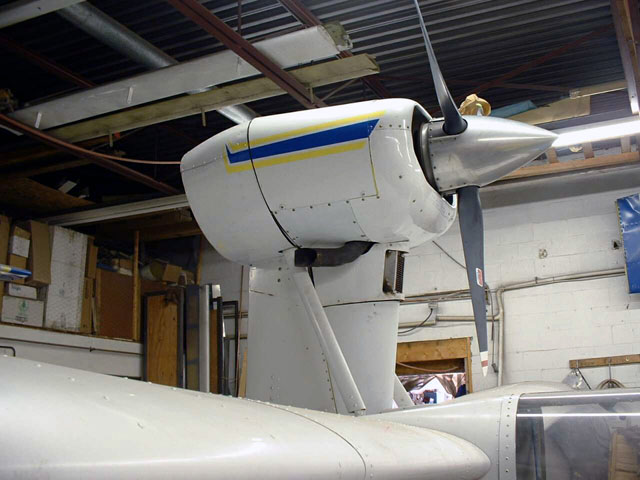
Engine and engine pylon on Teal C-GDQC (s/n 22)
Photo: © Ted Dirstein

The first Teal to have a more powerful engine installed was probably Teal C-GDQC (s/n 22).  Owner Tom Martindale installed a 180 hp Lycoming O-360 engine in the late 1980ies, on a new engine pylon originally designed by Dave Thurston for the TSC-2 Patchen Explorer - a surveillance landplane version of the Teal.

The Teals currently under refurbishment at Lake Central Air Services in Canada will have a choice between three different Lycoming engine models.

Lycoming Model O-320-A3B O-320-B3B O-360-A1H6
Type Certificate No: E-274 E-274 E-286
Power 150 hp @ 2700 rpm 160 hp @ 2700 rpm 180 hp @ 2700 rpm
Cylinders 4 4 4
Displacement 319.8 cu in 319.8 cu in 361 cu in
Bore 5.125 in 5.125 in 5.125 in
Stroke 3.875 in 3.875 in 4.375 in
Compression ratio 7.00:1 8.50:1 8.50:1
Weight 244 lbs 250 lbs 298 lbs
Ignition TCM S4LN21; S4LN20 Dual Magnetos TCM S4LN21; S4LN20 Dual Magnetos Slick4230; 4202 Dual Magnetos
Timing 25º BTC 25º BTC 25º BTC
Carburetor Marvel-Schebler MA-4SPA PAC HA-6 PAC HA-6
Fuel Grade (min.) 80/87LL 100/100LL 100/100LL
Oils Sump Cap. 8 qts 8 qts 8 qts
Propeller Shaft SAE AS-127 Type 2 Mod. SAE AS-127 Type 2 Mod. SAE AS-127 Type 2 Mod.
Teal Serial Nos: All 19 34, 36


Teal Airframe Modifications


Tri-cycle Landing Gear

Operating a Teal on land on its original conventional 'tail-dragger' landing gear will be one of the biggest challenges for a Teal pilot, at least in crosswinds.  The tail-dragger configuration will have its advantages when beaching or when taxiing in and out of water from ramps.  However, many Teal owners would undoubtedly prefer a tri-cycle landing gear for their normal Teal operations.

Tri-cycle landing gear on C-GDQC (s/n 22)

Tri-cycle landing gear on Teal C-GDQC (s/n 22)
Photo: © Ted Dirstein

During the 1980ies Dave Thurston designed a tri-cycle landing gear for the Teal.  Plans were made to offer the tri-cycle landing gear as a retrofit for Teals under the TSC-1A1T/-1A2T designation.  However, the tri-cycle landing gear has so far been installed on only one aircraft; C-GDQC (s/n 22) by Tom Martindale.  The tri-cycle landing gear has not been approved or STC'ed yet (to the webmaster's knowledge).  It is not confirmed that this configuration has been flight tested.

Gull-wing Cabin Doors

Tom Martindale also installed some very attractive gull-wing cabin doors on C-GDQC.  However, these doors have not been approved by Teal designer Dave Thurston.  It is believed that it could be difficult to have these doors approved - due to the proximity to the propeller arc.

Gull-wing door on C-GDQC

Gull-wing door on Teal C-GDQC (s/n 22)
Photo: © Ted Dirstein

Four-seat Interior

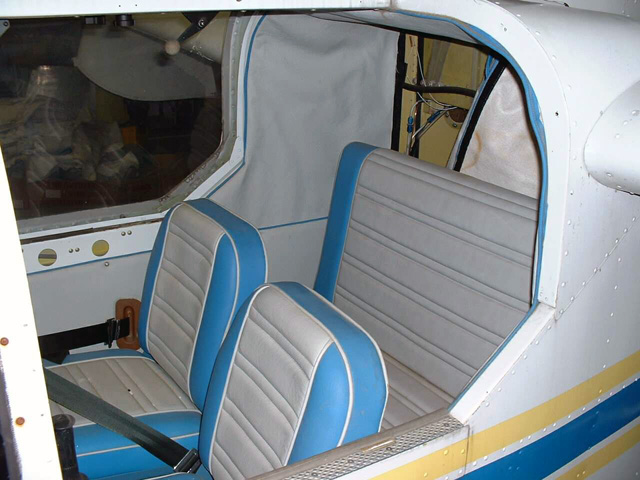
Moving the main gear into the tri-cycle position leave more room in the cabin.  On C-GDQC Tom Martindale installed a rear bench seat allowing two 'small' passengers.

Four-seat interior on C-GDQC.

Four-seat interior on Teal C-GDQC (s/n 22)
Photo: © Ted Dirstein

Extended Wings and Tailplane

When under manufacture at Schweizer, the Model TSC-1A2 with wing flaps was introduced to reduce T-O/landing and stalling speed.   This was done after one of the Schweizer's had a take-off accident on water with a TSC-1A1 Teal (non-flap) in heavy waves.

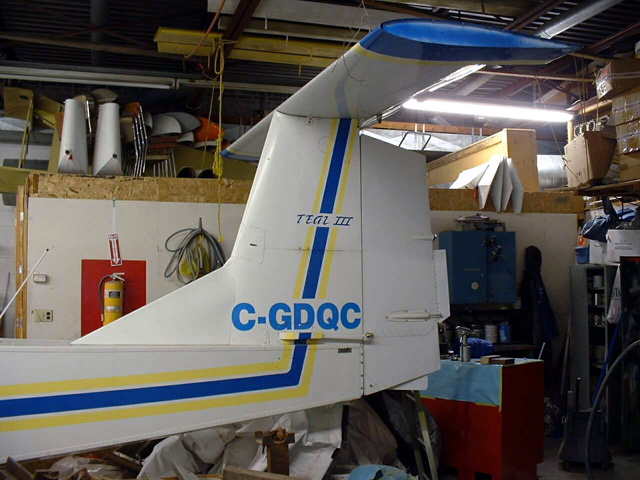
Extended tailplane and new rudder on Teal C-GDQC (s/n 22)
Photo: © Ted Dirstein

Dave Thurston always thought the best and most economical solution would be to increase wing span and tailplane span only, but the direction at Schweizer insisted on flaps.  Some years later Dave Thurston designed extended wings and tailplane for a few Teals modified to TSC-1A1/EW (Extended Wings) configuration by Tom Martindale in Canada.  Wing span is increased by 4 ft, tailplane span by 2 ft.  Modified aircraft included s/nos 1 and 15.  LCAS are currently installing EWs on s/n 3.

Home | News | History | Production | Specs | Mods | Operation | Photos | Literature | Market | Contacts | Links

Updated: 2008-09-11

e-mail

Copyright  © 2007-2008 Steinar Saevdal