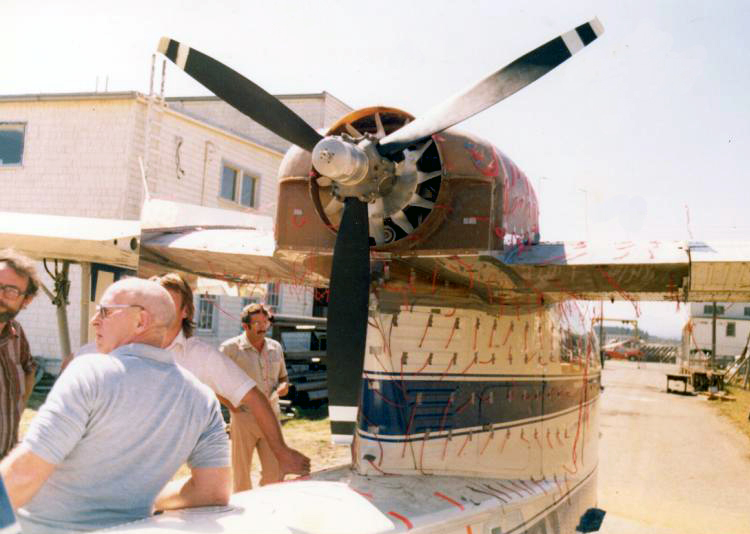
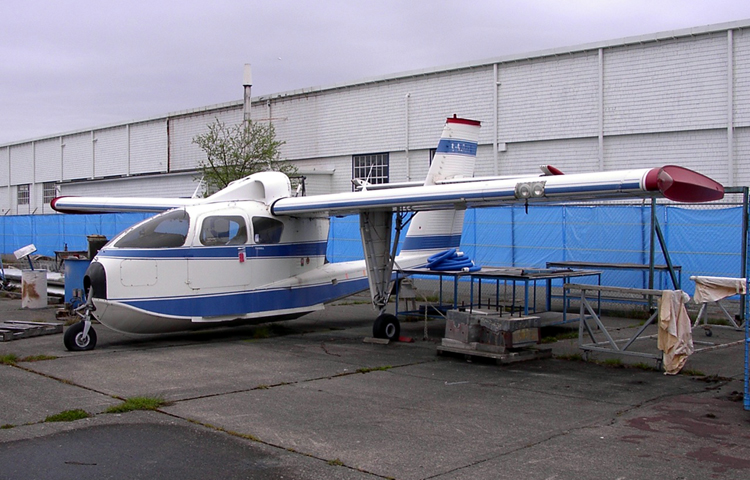
Notes from R. W.
(Bill) Walker!
Happy
to hear the Tri-Gull is going into production. As you may know,
Spence Spencer and his son in law, Chuck Herbst did most of the design
and engineering on it when the project was in Torrance, CA over 30 years
ago. Bob Dent in Seattle had commissioned them to design and build
it. They called it the Tri-Dent 320 at that time since there were
3 of them and the 320 came from the 320 horsepower Cont. Tiara engine it
was designed around. I heard about it then and followed the
project for some time until they ran out of money and were putting it up
for sale. By that time I had the Seattle Seabee Club established
and had Bob Dent come to one of our meetings to tell us about it.
Dave Hazelwood, who was the head of the Vancouver Seabee Club at the
time was there with several other Vancouver members. Over a short
period of time they put together a program to build it in
Vancouver. Chuck Herbst joined them as Chief Engineer.
Over the next 10 years, development
costs ran up about triple what they had originally estimated them to be
and they put much of the blame on Chuck Herbst for constantly changing
the design. They let Chuck go. They produced 3 aircraft,
which were now named the Tri-Gull because the British firm that produced
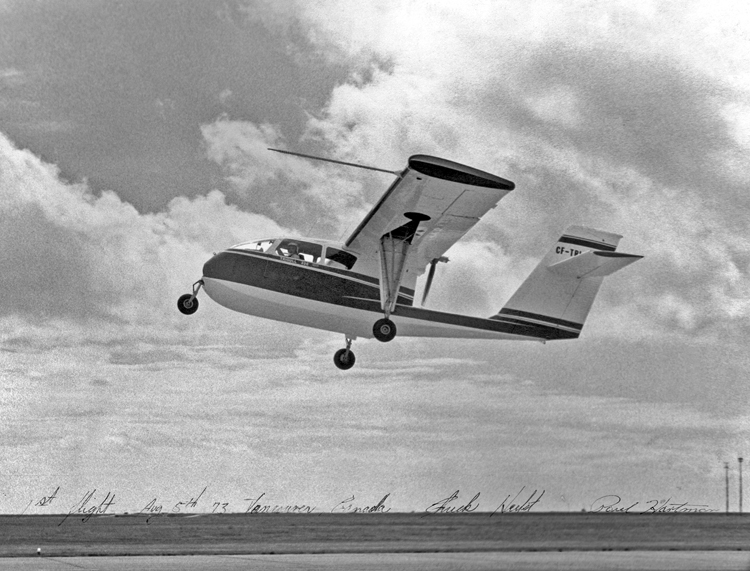
the Trident jet transport objected to the name. I was invited to
come up and fly one of the prototypes and wrote an article about it that
came out in one of the aviation magazines (can't remember which one
right now but I think I have a copy of the article). It flew very
well and I was very impressed with it. Unfortunately, Continental
was unable or unwilling to certify the Tiara engine for 320 horsepower
and didn't produce it. They installed a 300 horse Lycoming then
but had propeller matching problems and it never performed well after
that.
They did get a production
certificate for it, however and were buying tooling to produce it in
Victoria when the Canadian Government, who had put in 51% of the funds
changed hands and the new officials pulled the rug out from under it and
it was sold on the auction block to Clay Villas, a wealthy auto dealer
from San Jose who had the US marketing rights for the plane. I
lost contact with the Tri-Gull after that until your article in this
newsletter.
The turbine engine they are going
to power it with should certainly take care of the power plant troubles
it used to have. It should be a fine amphibian but way beyond the
budget of the average private owner. On the other hand, so is the
top of the line Lake Buccaneer but it is still selling airplanes.
The flight to 31,500 feet was indeed flown
in serial number 3, C-GATE. The pilot was Jerry Westphal. Jerry, an
ex-RCAF test pilot, replaced Norm Ronaason when Norm went to Canadair
for the CL-600 program. Ironically, Jerry went to Canadair after Norm
died in the CL-600 crash. The last I heard, he was retired in the
Montreal area.
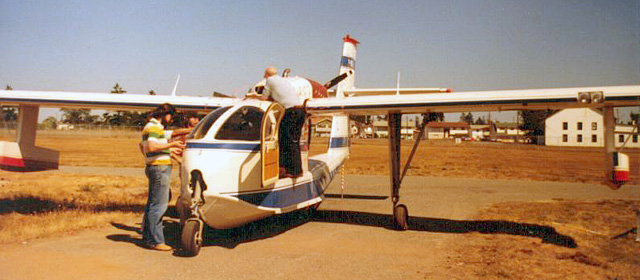
Photo: © Randy Komko
The picture captioned "CF-TRI after
getting a new paint scheme..." is actually C-GATE. When I first
looked at that picture, I thought, "I know where that was
taken". My next thought was "hey, I had shirt just like
that". Finally, it sank in. That's me, with the beard, standing
by the nose of the plane. C-GATE flew for about 2 years in primer,
before it was painted in the blue and white. The first attempt at
painting resulted in half the paint peeling within a few flights. I
helped strip the rest, before the next attempt. I remember oh so well
spreading stripper on the wing. Ah, the romance of aviation. That
might be Jack Scagel looking in the intake, but I can't be sure. I'm
quite sure that this is C-GATE. CF-TRI received a similar paint scheme
in about 1979/1980, but had not been fitted with interior panels (as
seen on the inside of the door in this picture) by the time I left the
firm in early 1980.
The caption is correct in stating that
C-GATE was used extensively for cooling trials with the Lycoming. We
tested 2 types, a turbo charged and a normally aspirated (both 540
cubic inch, I think). The turbo was a rocket, the other engine was a
total dog, that we quickly dropped. While in primer, and fitted with
the Tiara engine, C-GATE did most of the type certificate testing in
1976 and 1977.
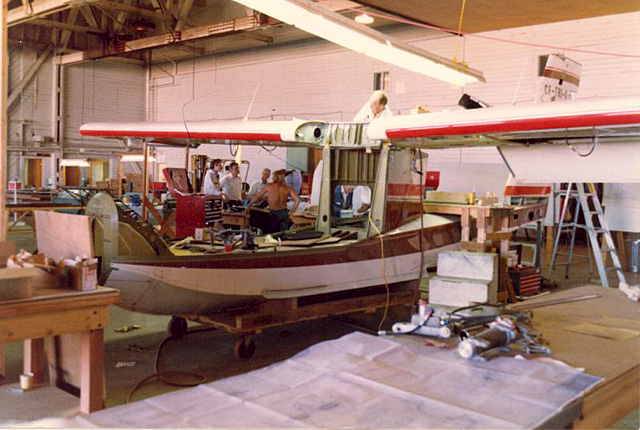
Photo: © Randy Komko
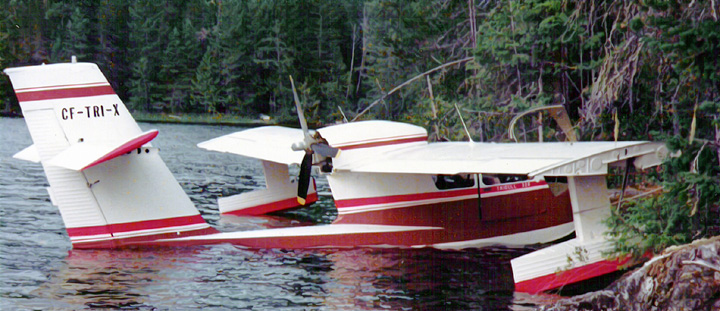
The other picture of CF-TRI, in red and
brown paint, is really CF-TRI. The original sheet metal cabin has been
removed, in order to received the fiber glass cabin as used on C-GATE.
It's hard to be sure, but I think the guy in the background without a
shirt is Ken Horten. At that time, Ken was the chief composite
engineer, and was almost single handedly responsible for all the
composite parts. He designed them, built the tools, and then built the
parts. Ken briefly became Chief Engineer at Trident, after John
Galizia left for de Havilland in 1980. The last I heard, Ken had
returned to his native Australia and was making a nice living making
wind surfers in his garage.
E-mail from Robert W. Walker
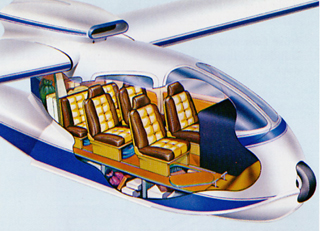 The cabin, forward of the
engine pylon, is of glass-fiber construction, with access through hinged
doors on each side. Five passengers, plus pilot, are accommodated
on three pairs of seats. There is dual control for use when a
second pilot is carried, or for instructional purposes. Fuel is
carried in a bag-type tank in the lower hull, and has a usable capacity
of approximately 100 US gal (378 litres). Baggage is stowed at the
rear of the cabin, below the floor.
The cabin, forward of the
engine pylon, is of glass-fiber construction, with access through hinged
doors on each side. Five passengers, plus pilot, are accommodated
on three pairs of seats. There is dual control for use when a
second pilot is carried, or for instructional purposes. Fuel is
carried in a bag-type tank in the lower hull, and has a usable capacity
of approximately 100 US gal (378 litres). Baggage is stowed at the
rear of the cabin, below the floor.